How Agencies Future-Proof Advertising Strategies with Trusted Partners
Agencies do not have an AI problem; they have an execution problem.
Everyone has “AI initiatives”, pilots, and a deck full of big promises. Then, Monday shows up.
The brief lands in an email while half the details are missing. Someone copies what is left into a form, and someone else retypes it into a CRM. Planning happens in one silo, pricing in another, and inventory in a third. Approvals happen wherever people happen to be standing at the time.
As for campaign management, it remains a daily spreadsheet ritual: export, paste, VLOOKUP, filter, panic, and repeat. This is not a lack of intelligence; it is a failure of operational design.
AI should not be a side quest. It should do the boring parts of the job automatically so that humans can do the work that actually matters. Operational AI is not a feature you buy; it is a philosophy of work.
1. Embedding AI into Core Media Operations
Ask anyone in media operations what they do, and they will describe a high-level strategy. Watch them for an hour, and you will see the truth: they are professional copy-pasters.
They spend their days turning messy briefs into structured inputs while chasing missing specs and rebuilding the same plan in three different formats just to satisfy three different systems. This is the work that never makes it onto a slide, but it is exactly what kills agency margins.
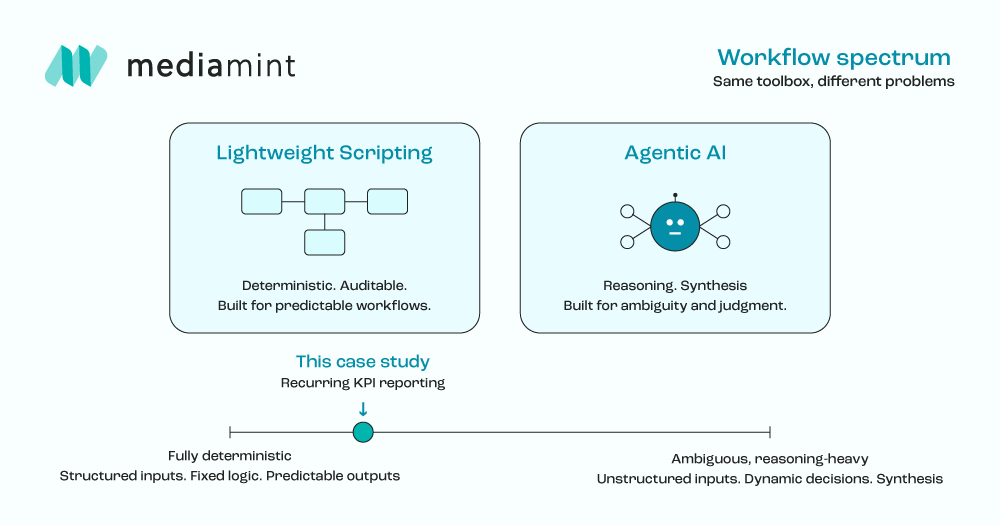
Operational AI targets this hidden work. A real agent acts like a capable assistant: it reads the unstructured mess of a brief, extracts the data that actually matters, and validates the basics before a planner wastes a single minute. It applies your specific agency rules on discounts and eligibility every single time without being reminded. This is not AI creativity; it is operational relief.
2. Data Foundations (Or, Why AI Makes Bad Data Faster)
AI does not fix bad data; it only makes bad data move faster.
If your information is scattered across CRMs, ad servers, and random inboxes, your AI strategy will quickly collapse into more busywork. This is why the industry needs an orchestration layer rather than another “rip-and-replace” software program.
An operational AI must connect to your reality. It needs to pull and push through the APIs you already use while handling the messy inputs, such as text, attachments, and emails, that define the workday. If a partner cannot explain exactly how their AI stitches into your existing stack, it will not survive the first week of actual operations.
3. Establishing Human-in-the-loop and Governance
The phrase “agentic AI” makes people nervous; they picture a machine taking the wheel while no one is looking. That is the fastest way to lose a client’s trust.
We do not want automation without accountability; we want automation with checkpoints. The rule is simple: the agent performs the work, but the human owns the decision.
This means building for step-by-step validation. The AI should show its work by identifying which inputs were used, which rules were applied, and what assumptions were made. Capability is not the same thing as good judgement. Governance is not just a compliance checkbox; it is the design choice that actually makes adoption possible.
4. Partnering for Specialized AI Capabilities
Agencies do not need “one platform to rule them all. “ We have all seen how that story ends, and it usually involves a three-year migration and a broken budget.
Instead, agencies need a set of trusted partners who excel at specific tasks and integrate without drama. Many tech companies are building AI inside their own “walled gardens”, which only works if you agree never to leave their ecosystem.
In reality, agency operations are inherently distributed. Planning touches intake, CRM, and inventory, while management touches delivery and pacing. The real differentiator is not whether you “have AI”; the differentiator is whether that AI can stitch your workflow together without locking you into one vendor’s universe.
5. The Litmus Test for Operational AI
To cut through the noise, ask one question: Does this reduce the friction in a task my team performs every single day?
If it does not speed up planning throughput or stop the spreadsheet babysitting, it is not operational AI. It is just AI content. But if it can turn a messy brief into a usable input while prioritising underperforming campaigns into an action queue, you are not just buying a tool. You are buying a calmer, efficient way to run media operations.
That is how you future-proof an agency: not by chasing more pilots, but by operationalising the work that actually needs doing.

Comment