The Agentic Pivot: What Databricks Data + AI Summit 2026 Means for Media & Advertising
Five signals from San Francisco, and what they mean for publishers, agencies, brands, and platforms
Summary
- At Data + AI Summit 2026, Databricks repositioned from a data platform into the place where enterprises build, govern, and run AI agents in production.
- The advantage no longer sits in the infrastructure, which is being solved for you, but in what your data means and how your workflows actually run.
- Five moves follow for media and advertising: pilot CustomerLake without ripping anything out, define your semantic layer now, put one production agent to work properly, find where slow data is taxing you, and stand up governance before you scale.
Every so often, a tech conference stops being a product update and points somewhere new. Data + AI Summit 2026 was one of those.
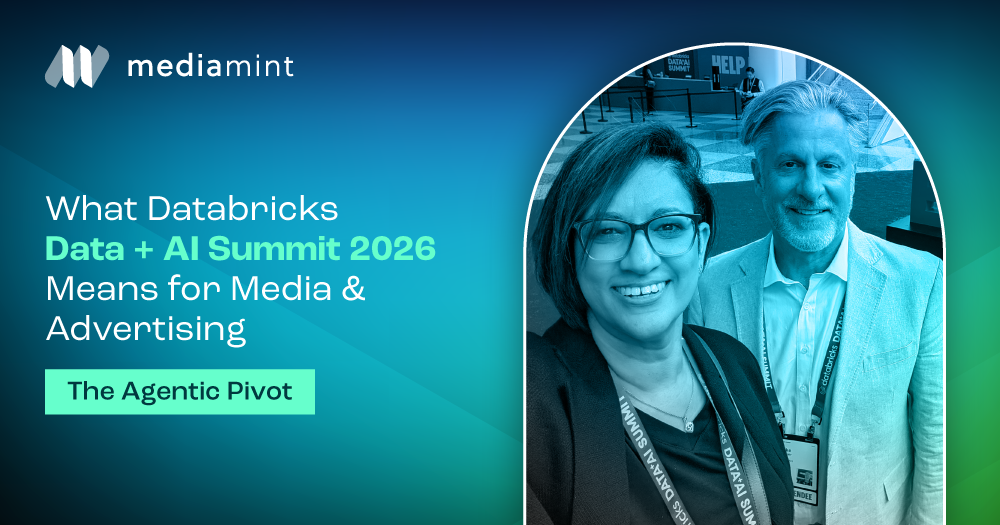
Michael Mayer, EVP, Media & Entertainment, and Nisha Sharma, SVP, Partnerships, spent the week at the Moscone Center alongside 30,000 other attendees. The guest list alone told you where things were heading: Greg Brockman of OpenAI on stage, Satya Nadella in a recorded fireside, and PepsiCo’s Chief Data and AI Officer speaking for the enterprise buyer. Media and entertainment were well represented too, with Alex Tenaglio of NBCUniversal, Nicole Catalino of Fox Corporation, and Michael Jones of Warner Music Group all presenting. The real headliner, though, was the platform itself.
Databricks has stopped positioning itself as a data platform. Now it wants to be where enterprises build, govern, and run AI agents in production. The lakehouse, the semantic layer, the agent runtime, and the governance piece, all of it got folded into a single story this year.
For anyone in media and advertising, none of this is abstract. It reaches monetization on the publisher side and the long handoff from planning to activation that agencies live with every day. Brands will feel it in customer engagement. Platforms will feel it somewhere else entirely, in how they govern data and AI at scale.
Five announcements stood out.
1. CustomerLake brings the CDP inside the lakehouse
Databricks CustomerLake is a customer data platform built directly into the lakehouse, rather than bolted on as a separate tool. It pulls customer 360, identity resolution, segmentation, activation, and campaign optimization into a single governed place, with agents handling some profile-building and campaign work.
This was one of the most energized moments of the week, and it is the one that lands hardest in our world. Brands can build engagement on the same governed foundation they already use for analytics, rather than running a parallel marketing stack and reconciling it after the fact. Agencies get a shorter route from audience strategy to live activation. For publishers chasing first-party data, it offers a native home for identity.
Our take:
this is exciting, and it is early, so plan for a lakehouse-native future and pilot it in a contained way, but do not rip anything out yet. Having worked both sides of this, the composable stack and the warehouse-native one, our view is that the winners will be the teams who get their identity spine right first because no CDP rescues messy identity.
2. Genie Ontology makes context the moat
Databricks Genie Ontology is a living layer of business context that gives AI agents trusted definitions, metrics, and the relationships between them. It arrived alongside Genie One, an agentic coworker for business users, and Genie Agents, which let teams build and share autonomous agents of their own.
An agent is only as good as its grasp of your business. Terms like make-good, fill rate, pacing, and sell-through carry specific meaning in our industry, and a general model has no idea what they are.
Our take:
this is the most important announcement here for our world, and the one with the least hype, because the ontology is only as valuable as the business meaning you load into it, and that meaning is yours to define, not Databricks’. Whoever encodes how media and advertising works, down to the edge cases a generic model never sees, gets a durable advantage that no platform upgrade erases, which is why we think clients should start that work now.
3. Agent Bricks grows into a full platform
Agent Bricks expanded from a building tool into a broader platform for deploying, governing, and scaling agents, with model choice, security, monitoring, and cost control built in.
We are moving past the copilot demo. What comes next is production agents that live inside real workflows, the kind you would trust to run ad sales operations or reconciliation rather than just answer questions about them.
Our take:
the gap between a demo and a production agent is mostly operational, not technical. So start small. Pick one workflow where a governed agent would clearly earn its keep, ad ops, say, or reconciliation, and run that one properly. Chasing a dozen at once is how these efforts stall. The best teams treat an agent like a new hire. It needs clear scope, real supervision, and someone checking whether it is helping.
4. The real-time foundation gets serious
Two infrastructure announcements sit under everything above. Lakehouse//RT delivers real-time analytics on the lakehouse with millisecond responsiveness, and LTAP is a new architecture meant to bring transactions, analytics, streaming, and operational data onto one governed foundation.
Media runs on freshness. Pacing, yield, bids, inventory, none of it tolerates yesterday’s numbers. This is the layer that turns real-time revenue and performance intelligence into something operational instead of a dashboard you glance at the morning after.
Our take:
this is the quiet enabler, and every pacing miss, late yield adjustment, or reconciliation that runs a day behind is a tax you are paying on slow data. We would map those moments first, because they are where a real-time foundation pays for itself fastest, long before anyone needs to talk about agents.
5. Unity AI Gateway puts governance front and center
The Databricks Unity AI Gateway extends Unity Catalog into runtime AI governance, handling policy, observability, identity, access, model usage, and, notably, AI spend across agents.
One refreshingly honest thread ran through the keynotes: agentic AI gets expensive fast on a consumption model.
Our take:
governance is not the boring part, it is the gate that decides whether you get to scale at all, especially in media where brand safety and privacy are not optional. Put governance and spend controls in place before you scale rather than after, because we would rather a client start governed and slightly slower than fast and ungoverned with a nasty invoice coming.
What this means for you
One idea holds the whole week together.
The platform layer is consolidating fast, and much of the foundation for running agents in production is being solved for you. What is not solved is the part closest to your business: what your data means and how your workflows actually run. The hard call is which decisions are worth handing to an agent at all. That is where the advantage sits now, and it is yours to build.
Pulling our five takes together: plan for CustomerLake but do not rip anything out yet; start defining your semantic layer today, because that is the real moat; pick one workflow and put a production agent to work properly; hunt down where slow data is taxing you; and stand up governance before you scale, not after.
Every one of those moves lives in the operations on top of the platform, not the platform itself. That is the work we have done with media companies, brands, and platforms for over a decade, across media, marketing, sales, and platform operations, and increasingly through co-created agents and accelerators. Databricks is building a remarkable foundation. Turning it into pacing that holds, yield that improves, and reconciliation that runs itself is the work we do.
This is no longer a “someday” conversation. If you want a clear-eyed read on where your business should lean in now and where to wait, that is the conversation we are having with clients across publishing, agencies, brands, and platforms. We would be glad to have it with you.
The Data + AI Summit 2026 keynotes are available to stream on demand, and registration is free.
To talk through what any of this means for your business, reach out to the MediaMint team.
Frequently asked questions
What did Databricks Data + AI Summit 2026 mean for media and advertising?
Data + AI Summit 2026 mattered for media and advertising because the platform layer for running AI agents is largely being solved, which moves the advantage to what your data means and how your workflows run. Five announcements reach our world directly: CustomerLake, Genie Ontology, Agent Bricks, the real-time foundation, and the Unity AI Gateway. The work that now decides outcomes is the operations on top of the platform, not the platform itself.
What is Databricks CustomerLake and what does it change for publishers, agencies, and brands?
CustomerLake is a customer data platform built directly into the lakehouse, pulling customer 360, identity resolution, segmentation, activation, and campaign optimization into one governed place. Brands can build engagement on the same governed foundation they already use for analytics, agencies get a shorter route from audience strategy to live activation, and publishers get a native home for first-party identity. Our view is that the winners will be the teams who get their identity spine right first, because no CDP rescues messy identity.
Should media companies adopt CustomerLake now or wait?
Plan for a lakehouse-native future and pilot CustomerLake in a contained way, but do not rip anything out yet, because it is early. The more durable work is getting your identity foundation right first, since that determines whether any CDP delivers. Treat the pilot as a way to learn, not as a migration to rush.
How does Genie Ontology apply to ad operations terms like fill rate and pacing?
Genie Ontology is a living layer of business context that gives agents trusted definitions, metrics, and the relationships between them. It matters for ad operations because terms like make-good, fill rate, pacing, and sell-through carry specific meaning in our industry, and a general model has no idea what they are. The ontology is only as valuable as the business meaning you load into it, so whoever encodes how media and advertising actually works gains an advantage no platform upgrade erases.
What do Lakehouse//RT and LTAP change for pacing, yield, and reconciliation?
Lakehouse//RT delivers real-time analytics with millisecond responsiveness, and LTAP brings transactions, analytics, streaming, and operational data onto one governed foundation. This matters because media runs on freshness, and pacing, yield, bids, and inventory do not tolerate yesterday’s numbers. Every pacing miss or reconciliation that runs a day behind is a tax you are paying on slow data, so we would map those moments first.
Where should a media or advertising team start with production AI agents?
Start with one workflow where a governed agent would clearly earn its keep, such as ad operations or reconciliation, and run that one properly. The gap between a demo and a production agent is mostly operational, not technical, and chasing a dozen at once is how these efforts stall. The best teams treat an agent like a new hire that needs clear scope, real supervision, and someone checking whether it is helping.
Comment